
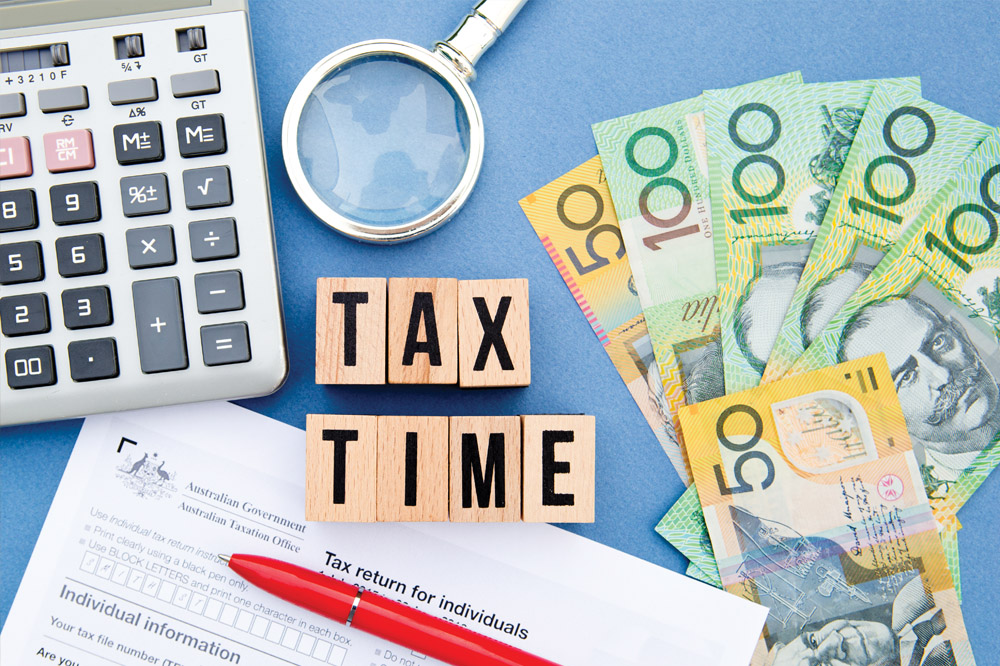
One factor that pushes people to take a break before pulling the trigger on a real estate investment is the fact that there are a lot of tax expenditures attached to it.
There is a capital gains tax on the gain in value, a continuous income tax on the rental profits, and unless your property is in the Northern Territory, another levy to pay is the property tax.
It is generally collected by the local state government on investment property that has a total taxable value above the property tax threshold.
"Property tax is marketed by state governments as applying only to large-scale property tycoons, but it can often affect mom and dad style investors. It is becoming increasingly important for state governments as a major source of revenue, so one would imagine that it will increase over time, "said Kym Nitschke, managing partner at Nitschke Nancarrow Chartered Accountants.
“It must be taken into account and planned when choosing the structure to use to buy a property. A carefully designed tax structure can minimize its impact in most cases.
”The property tax must be paid each year; the amount you pay is usually based on the type of land you own, its use and its overall value at the end of a given period – which can be the end of the fiscal year or the end of the Calendar year. Foreign investors may also be subject to certain surcharges.
However, in some cases, an owner may be exempt from paying the property tax. As a general rule, you will not be taxed if an accommodation is considered your principal place of residence (PPOR) or if the assessed value of the land is below the threshold.
Land tax regulations differ in some respects from Australian states. Some of the differences are explained here.
State-to-State Guide to Property Tax
NSW – In this state, the property tax applies to vacant urban and rural land; land with adjoining property; vacation home; investment properties; units under company names; all types of units, including parking spaces; and land leased from the state government.
The tax is applied regardless of whether the land generates income, although your PPOR remains exempt. Other exemptions include farms, which are considered primary production land, and land whose value is below the tax threshold, which is published by the appraiser general each October.
The amount of tax you pay is determined based on the total value of all taxable land you own at midnight on December 31 of each year. Foreign landowners are subject to a tax surcharge.
Property tax rate: $ 100 plus 1.6% of the value of the land above the threshold of $ 734,000, up to the premium threshold of 4,488 $ 000. After that, the premium applies, which represents 2% of the value of the land above the threshold.
VIC – As in New South Wales, the amount of property tax payable in Victoria is calculated on the basis of the total value of the taxable land held at midnight on December 31 of the year preceding the evaluation period.
If the property is used to generate income – for example, if what was originally your PPOR has since been leased – it will be subject to property tax.
Property tax rate: $ 275 plus 0.2% of the amount of taxable land equal to or greater than $ 250,000.
QLD – In this state, property tax is calculated based on the value of fully owned land at midnight on June 30 of each year. Freehold lands include lots in construction unit plans, group title plans and timeshare plans and those owned by housing corporations. The property tax thresholds vary for individuals and businesses / administrators / absent.
Even if you have not owned the land for the entire fiscal year, you will still bear the tax burden if you take possession of a property before June 30.
"Property tax is marketed as applying only to property magnates on a large scale, but it can often affect mom and dad style investors"
Property tax rate: After reaching the property value threshold of $ 600,000, you will pay $ 500 plus one cent for every $ 1 over $ 600,000.
WA – As in the case of Queensland, property tax is calculated on the basis of the assessed property value at midnight June 30. The appraiser general calculates the unimproved value of land in the state, which corresponds to the market value of land under normal conditions of sale, without structural improvements.
Land held in trust is generally not exempt from property tax, unless it is held in trust by the executor or administrator of a deceased estate and is occupied by a beneficiary as a PPOR, or if the land is held in trust for a disabled beneficiary who lives on the land.
Property tax rate: Flat rate of $ 300 for land valued between $ 300,001 and $ 420,000. From $ 420,001 to $ 1 million, a rate of $ 300 plus 0.25% applies. This percentage increases in increments to 2.67% when the total value of the land exceeds $ 11 million.
SA – The property tax here is calculated on the basis of the property value at midnight on June 30 of each year. When a property is sold after this date, carriers often negotiate a proportional tax adjustment between the buyer and the seller – this adjustment is usually calculated as if the property in question was the only taxable property.
Property tax exemptions can be claimed if the land is used for primary production purposes, such as agriculture. Off-plan apartments are also exempt.
South Australia recently made changes to its property tax policy: the 2019 Land Tax Amendment Bill lowered the maximum tax rate from 3.7% to 2.4%. However, it has also changed its aggregation rules. Investors will therefore not be able to use separate trust and company structures to avoid paying taxes.
This means that it will no longer be possible for an investor to hold multiple properties in multiple separate companies or trusts and not to pay a single dollar of property tax. The tax reform includes a $ 25 million transition fund over the next three years for investors who may be affected by the changes, which take effect in July this year.
Property tax rate: $ 0.50 for every $ 100 or part of $ 100 worth more than $ 391,000.
TAS – In Tasmania, property tax is levied on the basis of property on July 1 of each year. However, exceptions are made if the land is intended for use in religious activities, Aboriginal cultural activities, a charity or if it is intended for retirees (i.e. Location of a retirement village). Property tax is also exempt if the land is used for a medical establishment, excluding general practitioners, or if it is protected by a conservation commitment.
Property tax rate: $ 50 plus 0.55% of land with a value greater than $ 25,000.
ACT – In this state, property tax is levied on all properties that are not your PPOR. This includes properties held in trust and properties subdivided on the same land as your PPOR that are leased. Foreign landowners must also pay a specific supplement.
Property tax is assessed quarterly – the first day of July, October, January and April of each year.
Property tax rate: On land valued at $ 150,000, a rate of 0.50% of its unimproved average value applies. This percentage increases in increments to 1.1% when the total value of the land exceeds $ 2 million.
What Investors Should Look For
Given the cost of property tax, some investors will seek to minimize the amount they have to pay. You can do this by placing the properties under individual or joint names. However, Kym Nitschke has another tip that might work better in the long run.
"Although more expensive initially, using a family trustee can sometimes prove profitable over time due to the potential for savings on property tax and income tax over time, "he explains.
Nitschke also advises investors to stick to the real estate structure they initially set up.
.
"Changing structures to minimize property tax can trigger stamp duty and capital gains tax," says Nitschke.
When renting a property, owners can also give the responsibility for paying property tax to the tenant.
"In some commercial rental contracts, it may be written in the lease that it is an outgoing who is paid by the tenant, as opposed to the owner."
As investors build their portfolios, they should be ready to raise their tax rates.
"The value of land generally increases over time, so even if a property is not currently subject to property tax, it must be budgeted over time," says Nitschke.
"As investors accumulate their portfolios, they fall into a higher category of property taxes and the rates increase considerably by category. This can be a huge cost for successful property investors. »


